


Charnockite
Category: Plutonic
Type Orthopyroxene granite.
Commons Charnockite is an igneous rock belonging to the group of charnockitic rocks characterized by the presence of orthopyroxene (or fayalite and quartz), perthite, mesoperthite, or antiperthite. Charnockites are often associated with norites or anorthosites in ancient Precambrian terranes. Although many charnockites exhibit features characteristic of metamorphic rocks (deformation and recrystallization), they are classified as igneous rocks. The magmatic origin of charnockites was first published by Sir Thomas Holland (1893, 1900), who described charnockites from their type locality, the small hill Saint Thomas Mount in Pallavaram in the suburbs of Madras (now Chennai).
Name origin Charnockite was named by Holland in 1900 after the tombstone of Job Charnock (1630–1692), the founder of Kolkata (Calcutta), India, buried in St. John's Cemetery, Kolkata (Holland, 1900). In fact, Sir Thomas Holland described charnockite in his work "The petrology of the Job Charnocks' tombstone", published in the Journal of the Asiatic Society of Bengal in 1983 (Touret and Huizenga, 2012).
Locality Eastern Ghats Belt (EGB), Jenapore Massif, northeastern India near the Bay of Bengal (specimen donated by M. Kohút).
GPS: 18° 51' 3,35" N, 82° 36' 28,76" E
Major minerals Quartz, plagioclase, alkali feldspar, orthopyroxene, hornblende, clinopyroxene, biotite.
Accessory minerals Ilmenite, zircon.
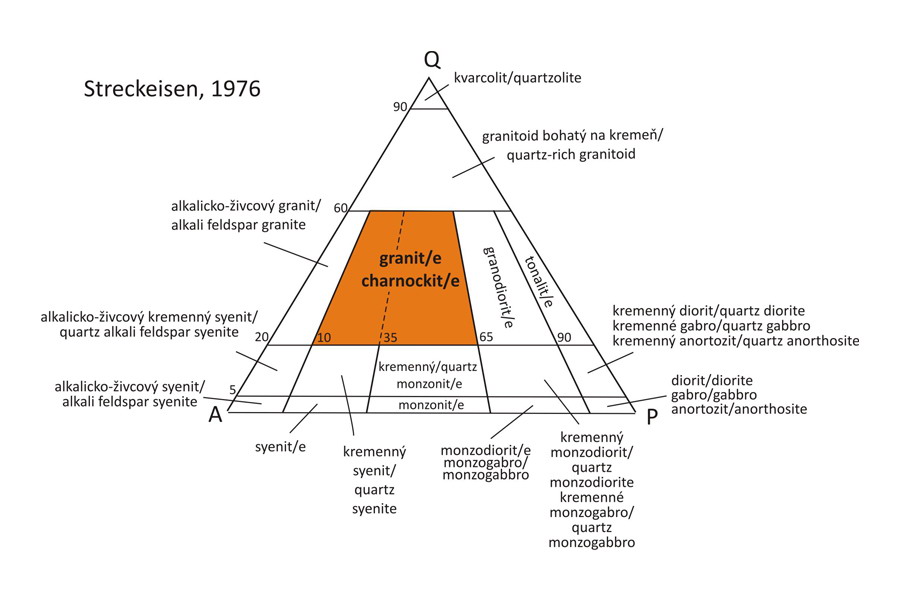
Classification The rock is classified according to the modal composition in the upper part of the QAPF diagram for plutonic rocks (Streckeisen, 1976). Charnockite is an orthopyroxene granite and in this classification it projects into the granite field, which defines a modal quartz content (Q 20–60%) and a P/(P + A) ratio between 10–65. Various forms of perthitic feldspars are found in charnockite, which are not part of the modal QAPF classification. The Subcommittee on the Classification of Igneous Rocks therefore recommends the following division of perthitic feldspars between A and P: perthite should be assigned to peak A, because it is an exsolution of albitic plagioclase in K-feldspar, with K-feldspar prevailing; mesoperthite should be divided equally between A and P, because the content of K-feldspar and Na-Ca feldspar - plagioclase (usually oligoclase to andesine) is approximately the same; and antiperthite should be assigned to P, because the main component is plagioclase (andesine) in which alkaline feldspar is mixed.

Colour Grey-brown.
Structure Massive, equigranular.
Granularity Medium-grained (1 – 3 mm).
Texture Phaneritic, hypautomorphic.
Alterations Rock is unaltered.
Petrographic characteristics The rock is composed mainly of quartz, plagioclase, and alkali feldspar. The main ferromagnesian mineral is allotriomorphic orthopyroxene. Biotite grains are found in the spaces between feldspars and quartz. The alkali feldspars are rarely perthitic and quartz occasionally encloses ilmenite needles.
Usage Decorative stone.
Literature Duchesne, J.-C. & Wilmart, E., 1997: Igneous Charnockites and Related Rocks from the Bjerkreim–Sokndal Layered Intrusion (Southwest Norway): a Jotunite (Hypersthene Monzodiorite)-Derived A-type Granitoid Suite. Journal of Petrology, 38, 3, 337-369. Holland, T.H., 1900: The charnockite series, a group of Archaean hypersthenic rocks in Penninsular India. Memoirs of the Geological Survey of India, Calcutta, vol. 28, 119-249. Holland, T.H., 1893: The petrology of the Job Charnocks´tombstone. J. Asiatic Soc. Bengal, 62, 162-164. Kar, R.K & Bhattacharya, S., 2010: New experimental constraints: implications for petrogenesis of charnockite of dioritic composition. Natural Science, 2, 10, 1085-1089. Rajesh, H.M., 2012: A geochemical perspective on charnockite magmatism in Peninsular India. Geoscience Frontiers, 3, 6, 773-788. Streckeisen, A. L., 1976: To each plutonic rock its proper name. Earth Science Reviews, 12, 1-33. Touret, J.L.R. & Huizenga, J.M., 2012: Charnockite microstructures: From magmatic to metamorphic. Geoscience Frontiers, 3, 6, 745-753.
Photomicrographs
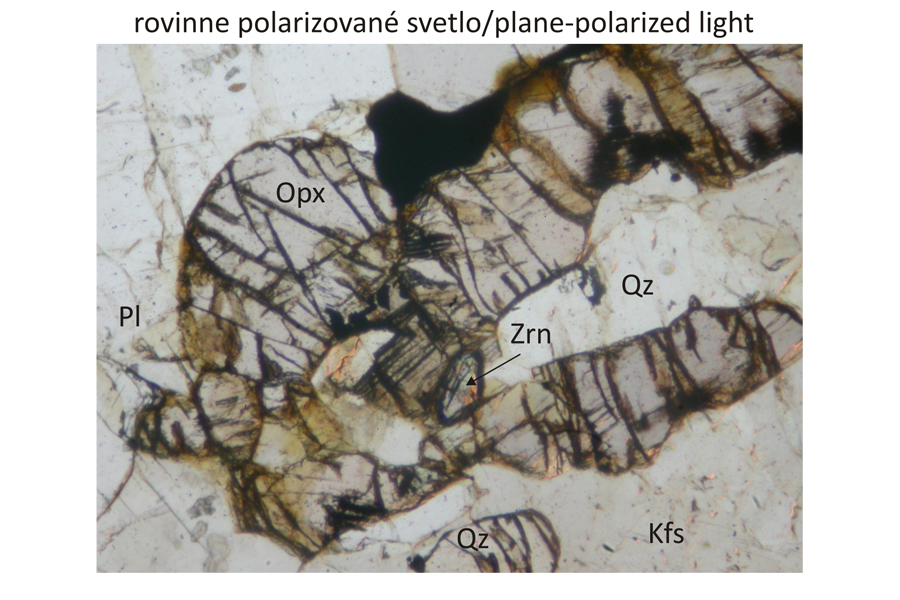
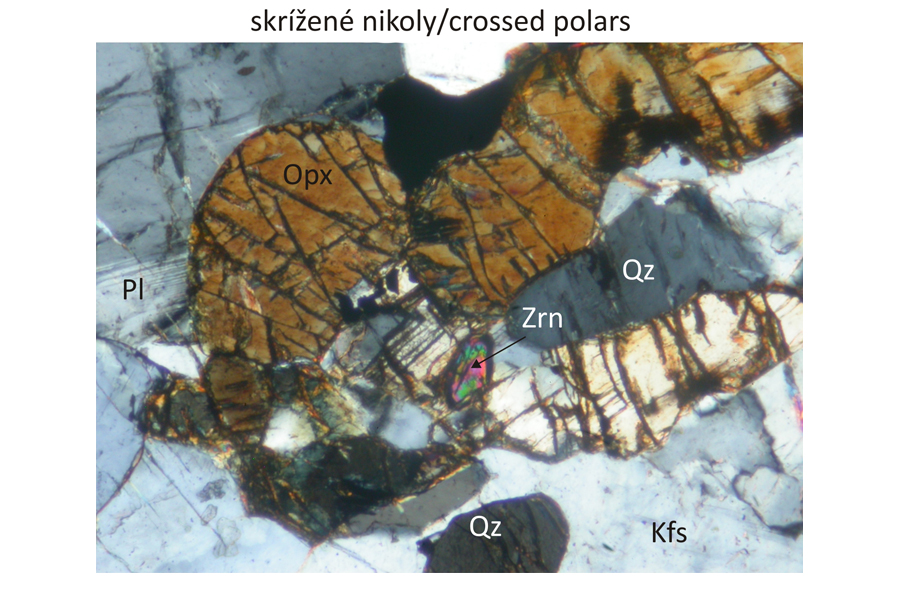
Allotriomorphic orthopyroxene – Opx between allotriomorphic to hypidiomorphically grains of alkali feldspar – Kfs, plagioclase – Pl and quartz – Qz. Orthopyroxene has good cleavage, positive relief and in crossed polars an orange interference colour from the first order of Newton’s interference scale. The main accessory mineral is zircon – Zrn, which has very high relief and in crossed polars high interference colours. The width of the micrographs is 2.2 mm.
Normative composition
Charnockite is a quartz-saturated rock. The FeO content in the normative composition is mainly bound to hypersthene – hy and to a lesser extent to diopside – di. The relatively low alkali content (Na2O + K2O) is reflected in the low normative content of orthoclase – or and albite – ab. The higher content of normative anorthite – an results from the higher CaO content. The remaining molar proportion of CaO is also bound in normative diopside – di.
Normative minerals
SiO2
TiO2
ZrO2
Al2O3
Fe2O3
FeO
MnO
MgO
CaO
Na2O
K2O
P2O5
F
S
CO2
Total
Molar proportion of normative mineral
Molecular mass of normative mineral
Weight % of normative mineral
Oxide
(wt. %)
49.69
2.90
13.85
2.38
13.64
0.22
3.75
7.90
1.14
2.07
0.75
98.29
Molecular
weight
60.08
79.88
101.96
159.69
71.85
70.94
40.31
56.08
61.98
94.20
141.95
Molecular
proportion
0.8271
0.0363
0.1358
0.0149
0.1929
0.0031
0.0930
0.1409
0.0184
0.0220
0.0053
ap
0.0176
0.0053
0.0053
328.68
1.74
il
0.0363
0.0363
0.0363
151.75
5.51
or
0.1318
0.0220
0.0220
0.0220
556.67
12.23
ab
0.1104
0.0184
0.0184
0.0184
524.46
9.65
an
0.1909
0.0955
0.0955
0.0955
278.21
26.56
mt
0.0149
0.0149
0.0149
231.54
3.45
zvyšky
0.1417
0.0930
0.0278
di
0.0556
0.0168
0.0110
0.0278
0.0278
235.60
6.55
hy
0.2070
0.1250
0.0820
0.2070
119.43
24.72
q
0.1314
0.1314
60.08
7.89
D: -0.1165
Mg/(Mg+Fe2+): 0.396
Total of normative wt. % 98.29
Comment The formation of normative minerals ended at quartz – q. Charnockite does not contain any special normative mineral.
Chemical composition
Charnockite differs from classical granite in its lower SiO2 content (49.69–54.45 wt. %), higher FeO content (7.78–13.64 wt. %), higher CaO content (7.9–8.68 wt. %), and lower alkali content Na2O+K2O (3.21–4.52 wt. %) (Kar and Bhattacharya, 2010). It is a metaluminous rock with a molecular ratio of Al2O3/(CaO+Na2O+K2O) = 0.74-0.81 and a molecular ratio of Al2O3/(Na2O+K2O) = 2.24-3.36. Charnockite has a high content of Ti (5820-17400 ppm), K (4338-8588 ppm), Ba (376-1527 ppm), Sr (296-341 ppm), Zr (117-329 ppm), Nb (11.6-35.3 ppm) and Th (1.51-8.84 ppm). The content of light rare earth elements La – Eu is also high, with the highest contents of La (47.5-92.7 ppm) and Nd (42.8-87.7 ppm). Charnockites represent either dry felsic magma (poor in H2O) emplaced in the lower crust, or they are granitic intrusions that were subsequently dehydrated during metamorphism (700 + 50 °C, 2-15 kbar) corresponding to the granulite facies (Touret and Huizenga, 2012). The magmatic age of charnockite from the Jenapor massif in the Rengali province is 2.9–3.0 billion years, the age of metamorphism of the massif is ~2.8 billion years (Rajesh, 2012).
Jenapore pluton, Eastern Ghats, Republic of India - JN-35A
SiO2
49.69TiO2
2.90Al2O3
13.85Fe2O3
2.38FeO
13.64MnO
0.22MgO
3.75CaO
7.90Na2O
1.14K2O
2.07P2O5
0.75LOI
1.54Total
99.83Mg(Mg/Fe2+)
0.33A/CNK
0.75A/NK
3.36
Kar - Bhattacharya, 2010