


Pincinite
Category: Plutonic
Type Glassy orthopyroxene granodiorite to tonalite.
Commons Pincinite is a fine-grained granite-granodiorite composed of quartz, plagioclase, potassium feldspar, ilmenite, orthopyroxene, and interstitial glass. The glass to mineral ratio is approximately 1:1.
Name origin Pincinite was first described as a xenolith in basaltic lapilli tuffs in a Pliocene maar near the Pinciná village, in southern Slovakia (Huraiová et al., 1996). The rock is named after the village and the maar structure Pinciná. Pincinite is a local name for a glassy orthopyroxene granodiorite to tonalite. So far, three pincinite fragments measuring 5–25 cm have been described from this locality.
Locality Pinciná, Lučenec district, Slovak Republic.
GPS: 48° 21' 52,47" N, 19° 46' 17,04" E
Major minerals Plagioclase Ab52-70An23-45Or2-8 in pincinite type I and Ab43-72An20-55Or2-8 in pincinite type II, non-undulous quartz in both types. Plagioclase is normally zonal, with a more basic core and a more acidic rim. Ilmenite and orthopyroxene crystallize from the intergranular glass.
Accessory minerals K-feldspar, apatite, zircon, monazite, allanite, rutile, corundum and chevkinite.
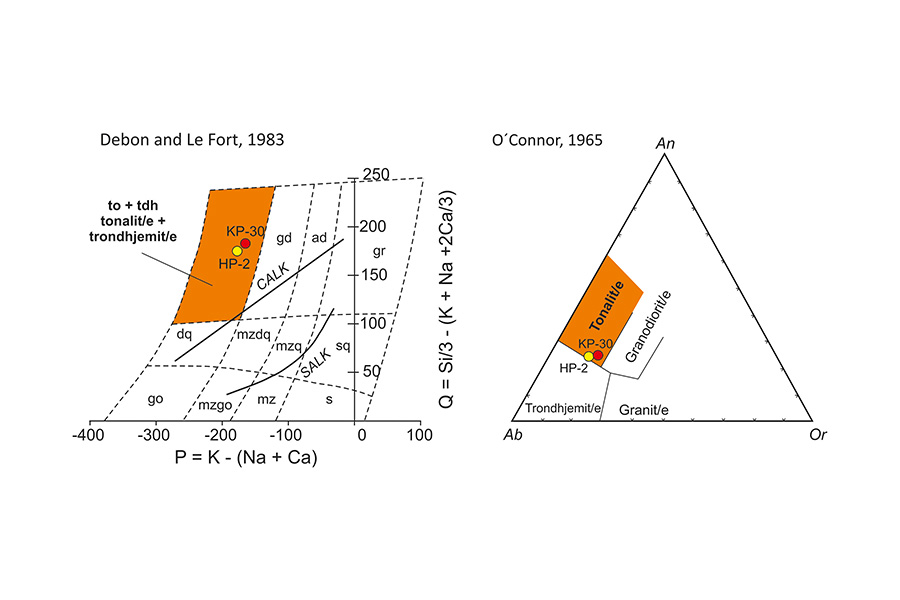
Classification Tonalite is classified in the P-Q classification diagram for plutonic rocks (Debon & Le Fort, 1983), according to the contents of the major rock-forming elements expressed in millications. In this diagram, tonalite is projected into the same field together with trondhjemite. The P and Q values for the pincinite sample KP-30 are: P = - 162.5 and Q = + 182.5, and for pincinite HP-2 P = - 175.0 and Q = + 176.0. The P-Q classification shows a subalkaline (monzonite) – SALK and a calc-alkaline – CALK trend. Abbreviations: ad – adamellite, dq – quartz diorite, quartz gabbro, quartz anorthosite, gd – granodiorite, go – gabbro, diorite, anorthosite, gr – granite, mz – monzogranite, mzdq – quartz monzodiorite, quartz monzogabbro, mzgo – monzogabbro, monzodiorite, mzq – quartz monzonite, s – syenite, sq – quartz syenite, to + tdh – tonalite, trondhjemite. The term adamellite has now been replaced by the term monzogranite. The conversion of whole-rock chemical analysis to milications is explained in Huraiová & Ondrejka (2016). Tonalite can be distinguished from trondhjemite in the classification diagram for phaneritic felsic rocks (granitoids) rich in plagioclase with a quartz content > 20% (O'Connor, 1965), which is based on the calculated abundances of normative minerals (Ab, An, Or) normalized to 100%. Tonalite can also be classified according to modal composition in the QAPF diagram for plutonic rocks (Streckeisen, 1976), where it is located in a field defined by a modal quartz content (Q 20–60%) and a P/(P + A) ratio between 90–100. This diagram is not shown here.

Colour Depending on the proportion of glass, which is black to black-brown, the color is black to black-brown with light gray-white grains of plagioclase and quartz.
Structure Phaneritic.
Granularity Fine-grained (0.1 – 1 mm).
Texture Phaneritic, equigranular with glass in the intergranular spaces.
Alterations Rock is unaltered.
Petrographic characteristics Fine-grained tonalite-granodiorite composed of quartz (10–20 vol. %) and plagioclase (30–40 vol. %). Silicate glass occurs in intergranular spaces. Orthopyroxene, ilmenite, + potassium feldspar crystallizes from the intergranular glass. The glass in xenoliths forms an interconnected network. Based on the different phases, chemical composition of the intergranular glass and fluid inclusions, two types of pincinite have been distinguished. Type I contains light green orthopyroxene crystals and black ilmenite, which occupy approximately 20–40 vol. % of the glass. The glass is significantly reduced, only containing 7 % Fe as Fe3+. Primary fluid inclusions in quartz are composed of a gas mixture dominated by CO2 and small amounts of CH4, CO, H2S and H2. Apatite, zircon, and orange-brown globules of ferric oxide melt are occasionally found in the glass (Hurai et al., 1998). Apatite and zircon are also enclosed in quartz and plagioclase. Type II has an almost homogeneous intergranular glass, with a small amount of ilmenite, orthopyroxene and K-feldspar (< 1 vol. %). The glass is strongly oxidized, containing 26 % Fe as Fe3+. Fluid inclusions in quartz are composed of a mixture of CO2 and H2O. This type of pincinite contains accessory apatite, monazite, allanite, zircon, and chevkinite. The water content in the silicate glass of both types is the same, around 2 wt.%.
Usage The rock has no practical use. It has only scientific significance because it is the first new rock-type described from the territory of Slovakia.
Literature Debon, F., Le Fort, P., 1983: A chemical-mineralogical classification of common plutonic rocks and associations. Trans. R. Soc. Edinburgh, Earth. Sci. 73, 135–149. Hurai, V., Paquette, J.L., Huraiová, M. & Konečný, P., 2010: U-Th-Pb geochronology of zircon and monazite from syenite and pincinite xenoliths in Pliocene alkali basalts of the intra-Carpathian back-arc basin. Journal of Volcanology and Geothermal Research, 198, 3-4, 275-287. Huraiová M., Konečný P., 2006: U-Pb-Th datovanie a chemické zloženie monazitu v xenolitoch syenitu a pincinitu z vrchnomiocénneho maaru pri obci Pinciná (Lučenecká kotlina), Mineralia Slovaca, 38, 2, 141-150. Huraiová, M., Dubessy, J., Konečný, P., Simon, K., Kráľ, J., Zielinski, G., Lipka, J. & Hurai, V. 2005: Glassy orthopyroxene granodiorites of the Pannonian Basin: tracers of ultra-high-temperature deep-crustal anatexis triggered by Tertiary basaltic volcanism. Contribution to Mineralogy and Petrology, 148, 615-633. Huraiová, M., Konečný, P., Konečný, V., Simon, K., Hurai, V., 1996: Mafic and salic igneous xenoliths in Late Tertiary alkaline basalts: Fluid inclusion and mineralogical evidence for a deep-crustal magmatic reservoir in the Western Carpathians. European Journal of Mineralogy, 8, 901–916. Huraiová, M., Ondrejka, M., 2016: Petrológia magmatických hornín. Vydavateľstvo UK v Bratislave, 356 pp (in Slovak). O'Connor, J.T., 1965: A classification for quartz-rich igneous rock based upon feldspar ratios. U.S.G.S. Professional Paper 525B, B79–B84. Streckeisen, A., 1976: To each plutonic rock its proper name. Earth Science Reviews. International Magazine for Geoscientists, Amsterdam, 12, 1-33. Wilson, M., 1989: Igneous petrogenesis. Unwin Hyman, London, 466 pp.
Photomicrographs


Equigranular pincinite composed of quartz – Qz and plagioclase – Pl. In the intergranular spaces, the silicate melt is brown in colour in plane polarized light. In crossed nicols, the melt is black, extinct, because it is amorphous and optically isotropic in transmitted polarized light. Orthopyroxene – Opx and ilmenite – Ilm crystallizes from the intergranular melt. Ilmenite is an opaque mineral (does not transmit light), it is black in plane-polarized light and crossed nicols. The width of the upper and lower two photomicrographs is 2.2 mm and 0.25 mm, respectively.
Normative composition
Pincinite is a quartz-oversaturated rock with a high content of normative quartz – q. The high content of Al2O3 is manifested by normative corundum – c created after normative feldspars (albite – ab, orthoclase – or and anorthite – an). The higher content of Na2O than K2O results in a higher content of normative albite – ab than orthoclase – or. Pincinite has a low content of both FeO and MgO, only hypersthene – hy appears in the normative composition. There was no remaining Ca needed for the creation of normative diopside – di after normative anorthite – an.
Normative minerals
SiO2
TiO2
ZrO2
Al2O3
Fe2O3
FeO
MnO
MgO
CaO
Na2O
K2O
P2O5
F
S
CO2
Total
Molar proportion of normative mineral
Molecular mass of normative mineral
Weight % of normative mineral
Oxide
(wt. %)
70.87
0.25
15.28
0.13
1.56
0.04
0.45
3.12
4.64
1.43
0.07
97.84
Molecular
weight
60.08
79.88
101.96
159.69
71.85
70.94
40.31
56.08
61.98
94.20
141.95
Molecular
proportion
1.1796
0.0031
0.1499
0.0008
0.0223
0.0006
0.0112
0.0556
0.0749
0.0152
0.0005
ap
0.0016
0.0005
0.0005
328.68
0.16
il
0.0031
0.0031
0.0031
151.75
0.47
or
0.0911
0.0152
0.0152
0.0152
556.67
8.45
ab
0.4492
0.0749
0.0749
0.0749
524.46
39.26
an
0.1080
0.0540
0.0540
0.0540
278.21
15.02
c
0.0058
0.0058
101.96
0.59
mt
0.0008
0.0008
0.0008
231.54
0.19
zvyšky
0.0183
0.0112
hy
0.0295
0.0183
0.0112
0.0295
119.99
3.54
q
0.5019
0.5019
60.08
30.15
D: -0.5019
Mg/(Mg+Fe2+): 0.378
Total of normative wt. % 97.84
Comment The oversaturation of the rock with Al2O3 is evident from the presence of normative corundum – c. The low CaO and high Al2O3 contents precluded the formation of normative diopside - di after normative anorthite – an, because the entire molar proportion of Ca has been exhausted for plagioclase.
Chemical composition
Pincinite is a specific plutonic rock with glass. Volcanic glass is not usually found in plutonic rocks. Glass is present in pincinite because the rock formed at depth was quickly brought to the surface as a xenolith in basalt before the crystallization was completed. Pincinite probably formed by partial melting of oceanic crust subducted during Miocene. The U-Pb age of zircon indicates a Pliocene age (Hurai et al., 2010). Silicate glass in the type I is peraluminous and corundum – c normative dacite (SiO2 content 65-71 and Na2O+K2O 6-8 wt. %), whereas type II contains slightly metaluminous dacite – trachyte to rhyolite, diopside – di normative glass (SiO2 content 64-76 and Na2O+K2O 5.5-9 wt. %). Pincinite type I is less oxidized, has a lower Fe3+/Fe2+ ratio in the intergranular glass, it does not contain K-feldspar and the ferrosilite component predominates in orthopyroxene. Pincinite type II is more oxidized with a higher Fe3+/Fe2+ ratio in the glass, it contains K-feldspar crystallizing in the glass, and the enstatite component predominates in the orthopyroxene (Huraiová et al., 2005). However, both types of pincinite do not differ significantly in terms of whole-rock chemical composition (see tab. chemical composition), which is projected into the subalkaline granite field in the TAS classification diagram for plutonic rocks (Wilson, 1989). Both pincinite types are peraluminous based on whole-rock chemical analysis (A/CNK = Al2O3/(Na2O+K2O) = 1.03 – 1.04 and A/NK = Al2O3/(Na2O+K2O) = 1.66 – 1.74). Both pincinite types also have an increased content of Ba (101-418 ppm), Sr (295-382 ppm), LREE and are depleted in HREE. Most geochemical indicators (high Si, Al, low Mg, Ni, Cr, high Sr/Y and La/Yb, positive epsilon Nd, 87Sr/86Sr = 0.705) are diagnostic of partial melt derived from subducted oceanic crust (adakite).
Pinciná, Slovak Republic - HP-2
SiO2
70.87TiO2
0.25Al2O3
15.28Fe2O3
0.13FeO
1.56MnO
0.04MgO
0.45CaO
3.12Na2O
4.64K2O
1.43P2O5
0.07LOI
1.90Total
99.74Mg(Mg/Fe2+)
0.32A/CNK
1.03A/NK
1.66
Huraiová, unpublished data
Pinciná, Slovak Republic - KP-30
SiO2
71.37TiO2
0.33Al2O3
15.50Fe2O3
0.28FeO
0.71MnO
0.02MgO
0.37CaO
3.27Na2O
4.32K2O
1.66P2O5
0.17LOI
1.80Total
99.80Mg(Mg/Fe2+)
0.41A/CNK
1.04A/NK
1.74
Huraiová, unpublished data